Nicole Seagriff, breast cancer survivor, promotes early detection
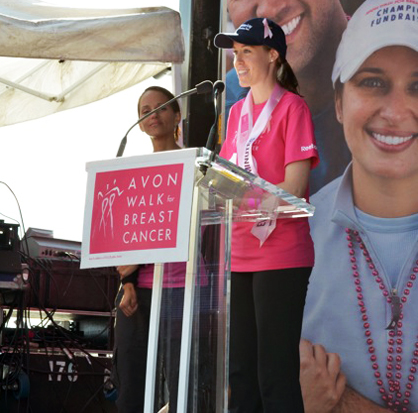
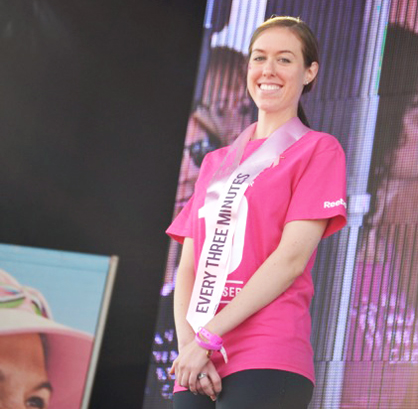
“My name is Nicole Seagriff, from Ridgefield, Connecticut, and I’m a 3-month breast cancer survivor,” the 27-year-old began as she addressed the crowd at the Avon Walk for Breast Cancer in New York City last Sunday. Seagriff had just completed an impressive feat: walking 39.3 miles around the city to raise money that will provide greater access to breast cancer screening and care for those in need. Yet, she already had another major journey under her belt: undergoing a double mastectomy that saved her life. Though the diagnosis at such a young age was terrifying, she says, “My story is one of happiness and hope.”
That story begins not with Seagriff herself but her grandmother, who died of breast cancer when her mother was only 4, and her mother, who faced the disease in her 40s and survived thanks to early detection. Sadly, her aunt also battled the disease while still in her 40s and died from it. From a young age, Seagriff understood that breast cancer could be in her future as well.
With this in mind, she opted for genetic testing at 26, three years before the recommended age. When both she and her mother came back positive for the BRCA2 mutation, a potential indicator for breast cancer, no one was particularly surprised and Seagriff started the baseline screening process with relatively little anxiety. Even when her MRI showed a mass, she recalls that, “I really did not even think it would be a big deal.” No one suspected that the cancer would strike a full 20 years ahead of schedule.
Yet, she was diagnosed with breast cancer just after her 27th birthday. Doctors informed her that, even with her family history, the chance of getting the disease at 27 was 1 in 20,000.
“I knew I was very high risk but I thought I had time to breast feed my children and have a normal 20s and 30s with my breasts and then face it in my 40s like my whole family has, so the fact that I was so young was shocking. It was shocking for everyone,” she said.
As she weighed her options, one statistic stood out: even if they were able to remove all the cancer this time, she would have a 60 percent to 80 percent chance of reoccurrence. She felt that dealing with breast cancer once was enough, and considered a double mastectomy. With this procedure and a five-year course of a chemoprevention medication called Tamoxifen, she learned that she could reduce her risk of reoccurrence to below 1%. Her choice was clear.
Though the physical and psychological toll of dealing with the surgery and “intense recovery” was great, Seagriff stayed strong with the help of her faith and “amazing” family. Now healthy, with an excellent prognosis and returning to her normal life, she is nothing but grateful. Whether it was the prospect of picking out a new breast size during the reconstruction process (“I don’t want to go too big!”), realizing the importance of friends or seeing the bigger picture beyond the every day trifles, she refuses to see the experience as anything but positive.
Perhaps most importantly, Seagriff reports that her experience with breast cancer has deeply affected her approach to her career. She works as a nurse practitioner in family practice serving primarily the uninsured and underinsured, and says that dealing with the disease from the other side has brought new respect for her patients. In particular, she recalls the “absolutely awful” days in which she thought her treatment might not be covered by her insurance. It ended up being a simple glitch in the system and she ultimately scheduled her surgery with the same Sloan Kettering doctor who performed her mother’s exactly ten years earlier. Yet, this mix-up, which briefly threw her whole treatment plan into uncertainty, left a big impression.
“It has given me additional compassion that I probably could have never felt for my patients that are uninsured and underinsured. I really gained a newfound respect for my patients because what they have to deal with is a million times harder than what I had to deal with because, at the end of the day, I did have my insurance. I could have my surgeries where I wanted at one of the best cancer hospitals,” she said.
Additionally, she has a newfound sense of purpose. She originally went into primary care because both of her parents are cancer survivors. To this day, she remains “so grateful that I have both of my parents because of early detection.” Now, after going through it herself, she has become an even greater advocate for breast awareness.
“I’ve definitely become better at educating people and I definitely am conscientious to not do it in an alarming or scary way but just to let our patients know that if they feel an area or if they’re concerned about something to come in and we can walk them through that,” she shared.
Seagriff notes that, although going through the genetic testing and screening processes can provoke anxiety, it ultimately provides people with the options that can save their lives. In her own case, she recognizes that if she had waited until 30 to start dealing with her breast cancer risk, “It would have been a very different story.”
While she knows she is lucky to come through breast cancer with such an excellent prognosis, it was her commitment to being proactive about her health that made the difference. And her infectiously positive attitude didn’t hurt either.
Today, Seagriff is inspiring people to be informed, know their bodies, and take care of themselves as best they can. While she knows better than most how terrifying breast cancer is, she wants people to know that it doesn’t always have to be.
“It can be something that happens, you catch it early and you can go on with your life,” she said.
Read more about breast cancer.
Tagged in: lux exclusives, new york, new york, causes, health, philanthropy, breast cancer, breast cancer awareness, breast cancer awareness month, avon walk, avon walk for breast cancer, nicole seagriff, early detection for breast cancer,

LadyLUX via Nicole Seagriff