A day in the life of a caregiver
Selena Johnson has to watch her mother all the time. With a video monitor. Suffering from dementia, brain damage from several strokes and more, her mother, Annie Ruth Wesley, is confined to a bed and unable to talk. Johnson has become her main caregiver, a responsibility she finds demanding yet rewarding. Learn why this November is National Family Caregivers Month.
It is a 24-hour, seven-day a week job. She rouses herself every two hours during the night to turn her mother and make sure her water tube is flushed. Johnson’s days are spent bathing her mother, feeding her through a tube and giving her medicine. She estimates she puts in 25 hours a week, on top of caring for her husband and six-year-old goddaughter and working toward an online master’s degree in Healthcare Management.
“It used to be overwhelming, and I used to be upset because I felt that there was enough of us to rotate the duty, but I realized that this kind of work and responsibility is not cut out for everyone, and I was the chosen one to have the patience to do this,” the 48-year-old said.
Usually the only assistance she receives is the nurse who comes in once a day to help turn Wesley due to her back sore.
“I don’t know what my life is going to be like after she is gone because my life has been consumed with taking care of my parents and it’s going to be different … whenever God calls her home, I don’t have any guilt and I will feel good. I will miss her, but I will feel good because I have done everything I could possibly do to make her life as comfortable as possible,” the caregiver said.
Johnson is not alone in her responsibility. More than 65 million Americans care for a chronically ill, disabled or elderly family member or friend, spending typically 20 hours a week providing care. A full 13 percent of caregivers put in 40 hours a week or more, reported the National Family Caregivers Association.
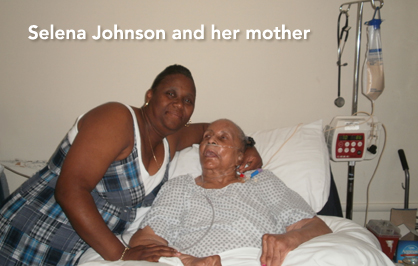
via Selena Johnson
In her third year of college in 1984, Johnson dropped out to take care of Wesley when she went into a coma. After recovering, her mother had to learn to walk all over again. Following her diagnosis with rheumatoid arthritis, for which she could not take medicine due to a bleeding ulcer, Welsey became worse and worse. By 2001, she was completely bedbound, fighting arthritis, dementia, congestive heart failure, Parkinson’s disease and diabetes, as well as brain damage from several strokes.
Although Johnson has six siblings, the brunt of the work fell to her.
“If I had to do it all over again, I wouldn’t give it a second thought. I would do it again,” Johnson said. “I cherish every second with her, and although she cannot speak, she is alert and recognizes me.”
This is not Johnson’s first round of caregiving. Subsequent to her father’s diagnosis with Alzheimer’s in 1995, Johnson struggled to work and take care of him simultaneously. She was forced to resign from her job in ER registration at a medical center, a position she held for eight years. He passed away a few years later.
Caregiving often brings economic strain. Women who care for family members are 2.5 times more likely to have incomes below the poverty line, and caregiving families have median incomes more than 15 percent lower than families who do not care for someone who is disabled.
Johnson is lucky enough to receive financial assistance from the state – $9 per hour she spends caregiving – but it is a big dip from her usual salary. “But it’s my mom,” she declared.
Her day begins rolling out of bed at 5 a.m. to help her husband get ready for work and give her mother a bath. After many doses of medicine, checking blood sugar, turning her mother, feeding her through a tube, giving her shots, laundry, making meals and looking after the house, Johnson wishes her mother goodnight at 10 p.m. In between, she sandwiches her homework for her master’s program and tries to find time to be with her husband.
Despite the massive time commitment caregiving requires, the hardest part is perhaps watching Wesley suffer. Each day, Johnson sits and watches her mother slip away, bit by bit, knowing she is powerless to stop it.
Johnson relates the difficulty of watching her mother “go from a vibrant pastor’s wife, active in all of our lives, to just pretty much laying there in a vegetative state, not knowing what is on her mind, her not being able to communicate with us, only through a look.”
Johnson searched for a caregiver for her mother so she could return to work, but didn’t like the available options.
“It never worked out. They wanted the pay but did not want to do the time,” she said. “I just realized no one is going to take care of her like I would want them to, so I put my life on hold to care for my mom and I vowed to do that till the day she died, like I did with my dad and uncle.”
Along the way, she has discovered that caregiving also involves taking care of herself. Every morning, she now carves out a few hours of personal time. Her brother watches her mother while Johnson takes a 5-mile walk. She flips the monitor on and does yard work or crafts, reads a book – anything to keep active and not just sit and watch.
“You get overwhelmed and you get so consumed in making sure your loved one is taken care of that you often forget about yourself,” she explained.
Having worked at nursing homes, Johnson has seen the loneliness and despair of residents who lie in bed with no one to visit them and no one to care. She urges families to keep their loved ones at home.
“It won’t stop them from dying, but they will know they are loved and someone really took the time to care for them and they will die more peacefully knowing someone took the time to care for them,” she said.
Her greatest reward is knowing that she prevented her parents from suffering such a fate.
Every time Johnson enters her mother’s room, she kisses her and tells her she loves her. What more is there to do?
For more information on caregiving or assistance and support for caregivers, visit www.thefamilycaregiver.org.
Tagged in: lux exclusives, philanthropy, caretaker, caretaking, caregiver, national family caregivers association, caregiving,
LadyLUX via istock