May 13: The Waldorf Celebrates Lit Lineage
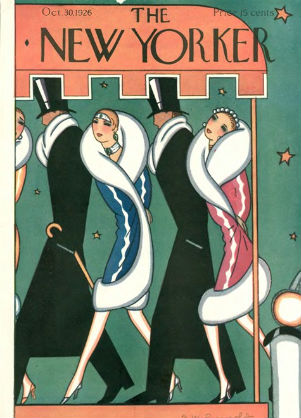
A posh reception for the Waldorf-Astoria Hotels & Resorts and The New Yorker was held Thursday night at the Waldorf-Astoria to celebrate 85 years of The New Yorker covers and the more than 20 landmark hotels of Waldorf Astoria Hotels & Resorts.
Hilton Worldwide, the parent company of the Waldorf Astoria Hotels & Resorts brand welcomed executives John T.A. Vanderslice, Global Head of Luxury and Lifestyle Brands, Hilton Worldwide, and Lisa Hughes, Vice President and Publisher of The New Yorker, the two landmark entities which came together at the celebration where various New Yorker covers were displayed from over the years. They will remain hung on the walls of the hotel over the course of the next 10 days for public viewing.
It was the first joint venture between these two LUX companies, time-honored brands whose names are synonymous with refinement. The Waldorf’s storied past, as the premiere luxury hotel located in the heart of New York City, makes it the perfect locale to kick off this event. Its reputation for unequaled hospitality has made it the hotel of choice for presidents, royalty, and Hollywood luminaries for over a century. Vanderslice commented on the strength of The New Yorker and the Waldorf and brands, and the strength of the luxury industry overall: “We’re so happy to be able to have come together for this night. We’re compiling a contemporary vision for the state of luxury across all categories, and the enduring appeals of the luxury experience.”
The magazine, a weekly publication which put out its first issue on February 1, 1925, is arguably the most renowned publication in the world. The first publisher, and founder, was legendary editor Harold Ross, who cemented The New Yorker‘s name as a literary publication, and the first cover-of Eustace Tilley, the fictional monocled Regency dandy who remains the recognizable face of the magazine-was drawn by the artist Rea Irvin. Writers who have become part of the canon and/or household names all got their start in these pages: Dorothy Parker, E.B. White, John Updike, Adam Gopnick, Wolcott Gibbs, F. Scott Fitzgerald, William Butler Yeats, Edmund Wilson, John Cheever, William Carlos Williams, James Thurber, David Sedaris—the list goes on and on and on.
Now owned by Conde Nast and under the excellent stewardship of Editor David Remnick, The New Yorker is vastly different than it was, at least in terms of its having stepped into the 21st century. Until less than a decade ago, the magazine was still simply a journal of great writing, with no photographs or artwork, save for its legendary illustrations. The only advertising the magazine possessed was displayed in columns along some of the left- and right-hand sides of the pages, small boxy ads for getaways to Acapulco or the latest book reading light. Iin 2010, there is a fully fleshed-out website where one can download podcasts of stories or an animated cartoon-app, The New Yorker festival each fall in New York City in which the famed writers congregate and speak, and there are a dozen or so blogs.
Yet it was the covers that were the focus of attention that night, and Francoise Mouly, the magazine’s Art Editor, was on hand to comment on her job: picking the cover illustration each week. Mouly admitted she has a huge responsibility—upholding a legend. She is only the fourth Art Editor in the history of the magazine, and she is a woman in love with what she does. “I unequivocally have the best job in the world,” she said.
Many would agree. Mouly’s task is more or less to pick out what will appear when readers pick up each issue, but she is always trying to balance what is in the magazine with what is going on in society to what is happening next. Her most memorable image over the years? Mouly is hard-pressed to pick a favorite. She commented that picking the image after September 11 was probably her most memorable moment. She drew upon the painting of Ed Reinhardt, which depicted the World Trade Center in black on a black background. What Mouly really likes is the diversity, she said, of artists like Robert Krum, Bruce McCall, Art Spiegelman, Wayne Tivo, all so vastly different in style yet all merging in the same New Yorker vein. Mouly feels strongly that the artists and writers should complement each other, that their two disciplines, although certainly different, converge superbly in this medium.
“People often ask me what I would change if I could. The only thing I would do differently is publish more art,” Mouly joked. She utilizes about 100 different artists over the course of a year in putting out the publication, but has a core group of about 20-30 that she uses on a regular basis.
Similar celebrations will be held at the end of this month at some of the brand’s European hotels, including the Trianon Palace Versailles and the Rome Cavalieri where the famed covers will be displayed as well. And, of course, readers can follow The New Yorker at their website, or on twitter and facebook.
Tagged in: new york, new york, john updike, waldorf=astoria, francoise mouly, the new yorker, hilton,
The New Yorker (2000)